Showing posts with label AI. Show all posts

Wednesday, March 22, 2023

Why Being An Agile Educator Matters In 2023

Welcome spring.  Three years ago, I wrote this, “How are you? It is one thing to have conversations around future ready skills like adaptability, communication, perseverance, problem solving, learning to learn, creativity.  It is a whole different story when the future is now and an entire public school culture makes a shift to eLearning in a week, at the same time families adapt to social distancing and parents adjust to working at home, and a stay at home order is put in place... but what stories we are writing!”   


How are you now? What stories are we writing now?  When I listen to colleagues, I hear below the surface a few common threads. First, it is taking our batteries longer to recharge than it did pre-pandemic.  It is as if we hyperextended our capacity for change from 2020-2022 and now we need longer to make shifts in thinking or absorb new information.  Second, priorities have been realigned.  The balance between home and school has been reset. Building relationships with students, filling in learning gaps…and at the same time finding opportunities for students to explore their interests, and continue to apply critical thinking skills, and make room for creativity…and …and… has taken more energy than anyone really appreciates or realizes.  


Learning agility refers to the ability to adapt to new situations or to see problems from different perspectives.  What does this look like for educators? Educator Agility. It does not look like yoga after school.  Agility is the ability to be flexible in thinking.  This may actually be how to conserve energy, and thrive through the day to day changes that have become so difficult to absorb.  It takes a lot of energy to try to put things back the way they were and to do things the way we did them pre -2020.  It is like trying to stand in one place while the tide is pulling around you. Instead, if we have Educator Agility, we flex.  If students need additional time and practice to acquire knowledge and skills. Flex. Maybe this means thinking differently about what activities are really essential vs nice to do because you have done them in the past. Be open this spring to cleaning out your “always did this” closet and make room to dig deeper into their learning. ChatGPT can help you brainstorm, provide differentiated problems, or suggest additional learning activities.  If you want to focus on topic A, and students are really interested in topic B…and you don’t really know anything about it. Flex. Become a learner along with them and integrate the standards into the new activities. ChatGPT can help with this too. Ask it to provide background info for you, new vocabulary for students, inquiry questions to spark curiosity.


Generative AI tools, like ChatGPT, are an opportunity to apply Educator Agility in the world of ELA. Especially around essay writing. The conversations around cheating and plagiarism are certainly valid. Ethical use of any technology is a necessary skill that students need to know.  Citing sources is also important, and because of the way generative AI algorithms function, it is not possible to cite the original source of the product it returns in response to a prompt. Students need to learn how generative AI tools work so they understand this. Learning how to communicate ideas and think critically through writing is also important. And, it is also taking hours for teachers to run student writing through ChatGPT detectors. What if instead, we flex. It is important for students to value the process and the struggle of learning. If we continue to emphasize that what we value is the final product, students will continue to find ways to get to that final product as quickly as possible so they can spend time on other things.  How can we think differently about traditional essay assignments and show students that we value the learning process?  Generative AI tools can be used to generate model writing that students can then work together to revise and improve upon. ChatGPT can create outlines that students can write from. ChatGPT can provide feedback questions, suggest word clarity, provide background information, or alternative points of view. It can do so much more than crank out average essays.  As educators, who are modeling agility, how can we model ethical use of this new technology and teach students to use it effectively as part of the learning process as well?  And, if we can move past the conversations about cheating, as Agile Educators, we can begin to explore how generative AI tools can help us be more efficient, finding that time we are looking for to build strong relationships with students, and be flexible, providing lesson ideas to meet the needs of our students. 


Resources To Spark Your Thinking

Friday, February 24, 2023

How Generative AI Can Help Find Common Ground Around Challenging Topics In Education - Social Emotional Learning

Wouldn’t it be great if there was a universal translator device that could analyze a conversation between people with opposing points of view and find common ground or suggest wording that would help both sides come to a level of understanding?  There are a number of challenging topics in the education dialogue right now.  Parents, community members, board members, teachers, administrators, and students are all tangled in crossed lines of communication and finding the right words to cut across those lines is increasingly difficult. Social Emotional Learning is one of those tangled lines.  On one side are educators who recognize the need to be intentional in teaching and applying communication, collaboration, organization, self-awareness and empathy skills. On the other side of that tangled line, parents, community members, board members and politicians who see SEL as something new, something different, something that they aren't sure is good for kids or should be in school.


Without a universal translator device, educators can still diffuse the conversation when it becomes emotionally charged or find common ground when opposing perspectives are shared.  I call this a connect the dots conversation.  I have found that asking the person who is questioning SEL, or any other curriculum, is to first listen to their perspective. What is it that they have heard or read that sparked their interest in reaching out to me? Are they willing to do a think aloud for me, helping me to see how they connected the dots to arrive at their conclusion or concern.  Often, this results in a walkthrough of how they heard/read and interpreted communication from the district, articles they have seen online, and conversations with other parents or community members that lead them to their concern.  This is really insightful, and is a chance to see the blind spots that may have existed in what I thought was a clearly written communication or assumptions I may have made about how much parents or the community knew or understood about the work of the schools. Sometimes the starting point of common ground is the fact that we both care about kids. It may take multiple conversations to get to the point where someone is open to having this conversation with you. It is worth the time investment, especially if the individual is a leading voice raising concerns.  I then ask them if they are open to hearing how I (or the team) connected the dots.  This is a chance to walk through the decision making process, or to emphasize the positive student outcomes the actions/plan will lead to.  I avoid jargon. I use examples or definitions vs acronyms when doing this.  For the SEL conversation, talking about why communication skills, self-regulation skills, and empathy  are skills we all need is a way to find common ground.  Making connections to their own childhood or school experience is effective.  The “Golden Rule”, counting to 10 before you speak when you are angry, think before you act, the early bird catches the worm… ask them how many of these phrases have they used? All of these phrases are related to social emotional skills, in fact, schools have been integrating these skills for a long time.  Citizenship, attendance, and learning skills have been report card categories in the past.  These are SEL too. Having this conversation, or including this information in school communication helps to reconnect tangled and broken lines.  


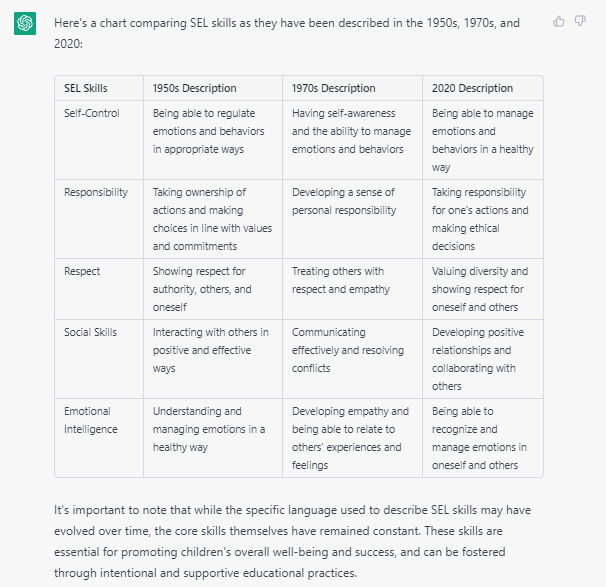
I don’t have a universal translator device, but I do have ChatGPT, so I asked it to help me find common ground around SEL.  First, I asked it to identify SEL language from the 1950s, 1970s and today and find common threads. This is one way to engage in conversation with individuals who feel that SEL is something new. 


Then, I worked with ChatGPT to identify words and explanations with neutral connotations that could be used to provide multiple entry points into conversations about SEL with individuals who are coming with their own perspectives.  After some refinement and feedback from me, the list ChatGPT and I created is below. 


  1. Communication: This skill is important for building positive relationships, resolving conflicts, and expressing thoughts and feelings in a clear and respectful way.

  2. Self-awareness: This skill involves understanding one's own emotions, thoughts, and behaviors, and how they affect others. It can help individuals to manage their emotions and make better decisions.

  3. Responsible decision-making: This skill involves evaluating different options and making choices that are respectful, safe, and aligned with personal values and goals.

  4. Empathy: This skill involves understanding and sharing the feelings and perspectives of others. It can help individuals to build positive relationships, communicate effectively, and resolve conflicts.


I can see using each of these at the center of a graphic that shows all of the different opportunities students have throughout their day to learn/practice/ get feedback on these skills.  Or, as small group discussion topics - maybe a jigsaw activity.  These skills are inner-related and also tie into PBIS initiatives.  The more we can demonstrate these connections and emphasize that this isn’t new, and that it actually enhances the academic time students are spending in school, the more likely we are to de-escalate conversations.   


Resources to Spark Your Thinking


Upcoming Opportunities 

  • Explore the new Learning Community available as part of the Future Forward Ohio. It is aligned to OTES 2.0 https://www.ohiolearningcommunity.org/ 

  • Missy McClain’s (Akron Children’s Hospital)  Modules hosted on the Mercer County ESC website - Understanding Trauma’s Impact On Children 

  • Do you have a passion for math? Have you thought about sharing an effective instructional practice with your peers? Now is your chance.  Join OCTM, the Ohio Council of Teachers of Math…and submit a proposal for the state math conference - Oct 12-13 at Kalahari Resorts. Proposals are open now - https://forms.gle/ftaaiRU2HDmuqPiJ7

Friday, February 17, 2023

How Generative AI Can Be Used To Identify Essential Background Knowledge and Vocab To Unlock Texts For Readers

Tonight I had the chance to play vintage Centipede.  As I moved the rollerball back and forth, my finger tapping the fire button, avoiding bouncing spiders and eliminating the centipede segments before they reached the bottom of the screen, muscle memory kicked in and for a few minutes, I was 19 again. And, I got a high score!  


Now, how many of you reading this have the cultural context to decode my opening sentences? If you do, you may be thinking about your own favorite arcade game.  If you don’t, it is possible that you still were able to comprehend this information because your own experience with games, and working vocabulary is broad enough to make the connections between rollerballs, fire buttons and screens to infer that this is an arcade game or at least a video game.  Shared experiences, like playing games, are a way to strengthen social connections, and are part of the common language of a culture. What happens when you haven’t had that common experience or can’t make a connection?  Imagine now that you are reading a text that includes cultural references or tier 3 vocabulary that you are not familiar with.  I have written before about the importance of text sets to build vocabulary.  They also provide a common foundation of information or experiences to all of the students in a class.  The text becomes the expert in the room and students can read about (or listen to, or see pictures of) the background knowledge and vocabulary they will need to access the core text or participate in class discussions.  So often, we assume our students have had similar experiences and opportunities. In doing so, we have blind spots in our selection of instructional materials and activities, then wonder why some students seem disengaged or confused.  Using text sets is an equity decision that can help to minimize our blind spots.   Generative AI can be an assistant in this process by helping teachers identify background knowledge, and the tier 3 vocabulary students will need multiple opportunities to work.  And, it can also help to translate this foundational information into the primary language of dual language learners who may not have had the same cultural experiences of their classmates. Here is a model of how to ask generative AI, like ChatGPT, to be a culture and vocabulary bot:


ME: ChatGpt you are a chatbot to identify current cultural references in a text and suggest background knowledge a student may need in order to understand them .   

ChatGPT: Certainly, I'm happy to help! Can you please provide me with the text in question and any specific cultural references that you would like me to identify and provide background knowledge on?


And here is what it responded when I pasted my opening sentences into it:

Based on the text, the following cultural references and background knowledge could be helpful for understanding the context

  1. Centipede - Centipede is a classic arcade video game released in 1980 by Atari, Inc. It is a vertical shooter game where the player must destroy a centipede and other insects while avoiding obstacles
  2. Rollerball - In the context of arcade video games, a rollerball is a type of controller that uses a ball for movement, as opposed to a joystick or directional pad.

  3. Bouncing spiders - In Centipede, spiders are enemies that move horizontally across the screen and can bounce off obstacles.

  4. High score - In arcade video games, a high score refers to the highest point total achieved by a player on a particular game. High scores were often displayed on a leaderboard, which encouraged competition among players.

  5. Muscle memory - Muscle memory refers to the ability to perform a physical task without conscious thought, often as a result of repeated practice or training.

Understanding these cultural references can help the reader better appreciate the author's nostalgic feelings about playing Centipede and the sense of familiarity that comes with muscle memory. It also highlights the importance of arcade video games during the 1980s and the social significance of high scores and leaderboard competitions in arcade culture.


I am at #OETC2023 this week and the conversations continue around generative AI.  As I engage in discussions about policy, safeguards, appropriate uses, not so appropriate uses, innovative uses, efficient uses…I had an aha moment.  Back to my Centipede game.  Computer games at one time were new technology, and there was a lot of concern about what impact they would have on students. Now, it is difficult to remember a time when there weren’t computer games, in fact there is a whole component of tech ed focused on gamification as an effective instructional approach. Then there was the creation of search engines.  There was a lot of concern about how search engines would lead to…cheating. Now, we can't imagine life without search engines. AI has been part of our lives for longer than we realize. It runs in the background of many of our day to day tools. Generative AI is unique because we are intentionally interacting with it, through natural conversation.  What experiences, and vocabulary, do educators need to build their own knowledge of this tech? What skills will we all need to develop or refine to use it effectively? 10 years from now, what will be on the horizon, and how will we look back on this year?   


 Resources To Spark Your Thinking… From Day 1 of #OETC2023

How Generative AI Can Help Us Close Equity Gaps

 I had the opportunity last week to talk with a colleague who is an instructional designer and a native of Cape Town, South Africa. She told me it is the most beautiful city in the world.  We talked about equity, or the lack of equity, in education in Cape Town and throughout many of the countries on the African Continent.  Her summary of education in a word is “ under”. Under funded, under resourced and teachers are underqualified.  In families where one or both parents have completed tertiary education (college) the children have a high probability of attending school. As you move down the education continuum of the parents’ educational experience, how the importance of education is viewed decreases and the ability to afford education becomes a barrier.  In Tin Can Town - the slums of Cape Town, children may not go to school at all.  The few schools that are accessible to those children do not have enough teachers, and the ratio might be 100 students to one teacher. Schools may only serve 500-800 students.  Children are often removed from school altogether as soon as they reach the legal age of 15 so that they can work and earn money for the family.   While South Africa has laws and policies that require handicapped access, these are often ignored. It is not uncommon for school buildings, and restrooms, to not be handicapped accessible. Students with physical disabilities may not physically be able to access the schools.   Corruption has resulted in a diversion of resources from children and schools.  In more rural areas, there are no libraries, there may be limited power, there may be limited water.  


Her passion is access to education, especially for girls.  What keeps girls out of schools? The cost of books (less than $10 of US currency) The access to transportation. (School buses are not common) The access to computers and internet infrastructure (Many schools have no computers, computers pr tech in homes in Tin Can Town are at high risk of being stolen) And, the access to feminine hygiene products. (They are expensive, not readily available especially to girls that don’t have access to a store, and there is Value Added Tax -VAT on top of the base cost). Children are often removed from school altogether as soon as they reach the legal age of 15 so that they can work and earn money for the family.   She asked if we had limited power, she had heard there are places in the US that don’t have regular power. Cape Town has power 10 hours a day.  She spends time volunteering with children. Some live in Tin Can Town.  How, she asked, can you help a child when they don’t have even the most basic learning and they are in a family impacted by generational lack of schooling. The example she shared was looking at the trajectory of an 8 year old girl - how could she hope to attend tertiary school when she couldn’t even identify simple shapes, read or write.  Where to even start in tutoring this child? She sometimes wonders if she is even making a difference. 


I have been thinking about our conversation for a week. I reflected on the educational divides that still exist in the United States, and what our schools are doing to address it. Worth noting, in a 2016 article on NPR, author Corey Turner discusses the concept of segregated borders in education throughout the US.  Three of the top 10 borders he discussed are in Ohio. (See the full Opportunity Atlas HERE) While public school is free, the school funding system in Ohio is still not perfect. The Fair Funding formula is the closest we have come in many years for identifying the cost and a plan for equitably funding a well rounded, high quality education for every child. I know that during the pandemic, there were children who did not attend school at all. How many of them still have not returned? Where are they?  And, in the United States, generational lack of schooling is a factor that will have a lasting impact on the future success of a child. I appreciate our policies that have protected access to public education in the US - including child labor laws, a mandatory education age of 18, Title 1, and enforcement of IDEA and FAPE.  And I have a similar concern about the lack of access to resources, both computers and internet infrastructure in regions of our state and our country. 


She and I are working together on a project around generative AI. We started talking about it as an equity tool. Think about the possibilities of using an inexpensive device and cheap headphones, along with  generative AI, a camera that can scan any written material, and text to speech to create something that can then provide simple explanations of steps to complete a task, or simplify complex information to make it accessible.  Layer in the ability for generative AI to translate into multiple languages, and the tool then provides access to refugee children and adults to education and job opportunities.  She shared with me that she met a refugee who was acting as a car guard (someone you can pay to sit by your parked car) who was an accountant in the Democratic Republic of Congo. Two barriers prevented him from finding a job as an accountant in Cape Town. First, he spoke only French. Secondly, and more limiting, he had never used any technology tools. No excel spreadsheets or accounting systems, no computer - ever. Instead, he was trained to be an accountant using ledger books and paper.  I am sharing this because we need to think beyond the boundaries of our classrooms, our district, our state, our country as we work for equity.  All people deserve the opportunity to be their best selves, to be safe, to be seen.   As my colleague shared, we should not be able to look at a child who is 5 and know that some opportunities for their future have already been taken off the table.  


Resources to Spark Your Thinking


Upcoming Opportunities:

  • Do you have a passion for math? Have you thought about sharing an effective instructional practice with your peers? Now is your chance.  Join OCTM, the Ohio Council of Teachers of Math…and submit a proposal for the state math conference - Oct 12-13 at Kalahari Resorts. Proposals are open now - https://forms.gle/ftaaiRU2HDmuqPiJ7 

  • OELMA is offering a free webinar - Clear the Digital Clutter! March 1, 7:00-8:00 PM Angela Wojtecki, Past President of OELMA, is offering a free one-hour session on Wednesday, March 1, entitled "Clear the Digital Clutter."  Angela has all kinds of simple tricks of the trade to help us organize our email.

  • February 9  4:15 PM Virtual SECO (Science Education Council of Ohio) Free Grade Band Science Meet-up. This is the 3rd one this year, open to all grades, and a great chance to network with colleagues from across the state.

Wednesday, January 25, 2023

How Are Knowledge, Information and Data Related To Each Other?

 How are the concepts of knowledge, information, and data related?  As education leaders, these concepts are central to our work. For our students, being able to see the connection between knowledge, information and data is a key to becoming an independent learner.  We talk about knowledge using terms that emphasize our belief that knowledge does not have boundaries.   Knowledge can be built. Knowledge can be grown. Knowledge can be expanded.  Experiences and opportunities can add to existing knowledge.  Education standards are a way to describe a continuum of knowledge and skills that stretches from kindergarten through high school.   One way to define knowledge and make a connection to information, is to think about knowledge as a result of organizing and interpreting information in a meaningful way. Layered onto that are the learner’s personal experiences and insights.  I like this definition because it does NOT include memorizing information.  And, as I spend more time interacting with ChatGPT,  it has the ability to access thousands of pieces of information, organizing it to respond to conversational queries. The part of the knowledge definition that AI isn’t bringing to the conversation is personal experience and insight.  So knowledge really has no boundaries if we can continue to access information, and have new experiences leading to new insights and interpretations of the information we are constantly gathering. ChatGPT can be a partner in this process. 


What about data?  If knowledge comes from the act of organizing and interpreting information, then information comes from organizing and analyzing data.  Data can be numbers, text, images, hash marks, observations, symbols. Data by itself is just data. It is the organization and interpretation of the data, and putting it in context that results in useful information.  How does this affirm or make you think differently about your data discussions/data protocols? I think about OTES/OPES, and MTSS.  Knowledge of students is tied to data.  Being intentional about identifying what information you already know about the students and what information you need to build on that knowledge can guide your decision on what data to collect and how to organize it.  Looking at data as a team adds each member’s own experience and insights to the data conversation, expanding the knowledge that comes from the work.    How can you help your students see the connection between data, information and knowledge - and why their own experiences and insights are a part of the process of building knowledge? ( and how AI like ChatGPT can be a resource in doing this?}  How can we remind ourselves that in a world where we are surrounded by data, and by information - it is our ability to find insight and inspiration through the process of organizing, re-organizing and interpreting information in a wide range of contexts that continues to grow our own learning. 


IMPORTANT NOTE: I know many districts are discussing ChatGPT.  As in all new technologies, it is always important to think about student and staff data privacy, student acceptable use, and safe student access.  Artificial Intelligence is a tool that will continue to expand into the education space.  My ChatGPT webinar session looked at how a student could use the tool in a positive way - as a balance to the conversations around how AI can be used as plagiarism, a legitimate concern.  Currently, the age requirement on ChatGPT is 18+ years of age.  As educators, looking at the tool through a student lens may give you insights on how we can use ChatGPT and other AI to help us find more efficient ways to support all learners in our classrooms.   


ChatGPT Data Privacy Policy https://openai.com/privacy/ 
ChatGPT Terms of Use https://openai.com/terms/ 


Resources To Spark Your Thinking


Upcoming Opportunities:


Wednesday, January 11, 2023

How ChatGPT Can Meet The Individual Needs of Teachers and Students And Change The Way We Think About Writing

I was thinking about what to write as my first Talk-OH-Tuesday of this new year. So I asked the newest AI tool, ChatGPT, to write a Talk-OH-Tuesday in the style of Char Shryock.  And here is the first important thing to note about this new Artificial Intelligence tool - It is not familiar with me, or my writing style and preferences, so it can not write in a style similar to me.  What it was able to do was write a short blog about the importance of emotional intelligence in the workplace. I asked it to try again, and it wrote a second blog about good communication.  Both of the blogs contained accurate information, although there is no guarantee that ChatGPT will produce accurate information. It is not connected to the internet, instead it pulls from a large database of knowledge layered over human language patterns. What I felt was missing from the writing was a “voice”, the unique word choices or phrasing that moves a piece of writing from stilted to flowing. I noticed that the writing is sometimes repetitive and that the transitions feel choppy.  I interacted with ChatGPT for an hour, trying science concepts, math problems, poetry, writing to different grade levels, summarizing stories, creating recipes, writing in Spanish, and even writing a bedtime story. I approached it through a lens of curiosity.  Here is what I found. 


First, I wondered how we can think differently about student research and writing based on the capacity of ChatGPT and other AI tools. It’s the real elephant in this post.  This isn’t a new conversation, just a new technology.  Students excel at finding work arounds for writing their own essays. One headline read ‘ChatGPT, the Death of English Class”. Nope. A change in English class, but certainly not the death. There is so much that can be learned by engaging with a text, and with others who are engaging with a text and bringing a variety of experiences to a text. Build on that. Audit your assignments, what is the purpose of the student writing? What other ways can they demonstrate their thinking? Stop assigning essays that can be written by a chatbot, or google searched, or found in someone’s old school “test file”.  Spend time on the process of iterations/drafts of writing, refining thinking, establishing voice, word selection, choosing and evaluating evidence. Let the chatbot write an essay and spend time as a class improving and critiquing it. Revisit how you incorporate the speaking and listening standards in your lesson planning, at any grade level.  Listening and discussing anything, fiction or informational text, builds vocabulary, and allows students to make connections between existing and new knowledge. Students learn when they have the chance to hear the thinking and questions of their peers. And remember, the chatbot is not an internet search engine. The information that it shares may be accurate, it may also be inaccurate or a mix of both.  Teaching students how to verify information and to work with AI as a tool that can make their own learning or work more efficient are important skills.


Next, I wondered how teachers could use this tool to meet the individual needs of students in their classroom.   What I found is ChatGPT can quickly write summaries and explanations of a concept or a novel at a variety of grade levels, adjusting vocabulary and sentence structure accordingly.  It can also do this in Spanish.  Teachers can use this to create short text sets for students to work with in class when the focus is on building content knowledge or building academic vocabulary. The chatbot will even pull the academic vocabulary words out of the text it has just written if you ask it to,  or it will incorporate academic or Tier 3 content words in the passage if you include them in your prompt.  It can be used to support vocabulary development for English Learners. It has a broad knowledge base and can be accessed for any content area.  I used it to write 5 math story problems with missing addends, and then translate them into Spanish.(This took it all of 30 seconds) I asked it to write basic knowledge paragraphs about science concepts at different grade level complexity, and then rewrite them in Spanish.  There is a lot of potential for efficiently creating individualized passages for students.


Finally, I pushed the edges of the chatbot. I asked it to write poems.  It can write different forms of poetry without actually understanding the imagery that words can create. So, it writes poems with really wonky rhymes and word selections.  Poetry is a form of writing that requires synthesis, inference, analysis and intentional word choice.  If you are looking for a writing task for students that is difficult for AI to replicate in any content area, having them share ideas through poetry is one option to consider.  I encourage you to create an account and try it yourself.  It has the capacity to regenerate a response to a question or task you present it, while keeping track of the prior responses. Look at the differences between each version.  Try giving it word limits, ask it to write to a certain grade level, ask it questions that you or your students wonder about. Fact check it.  Think about how it may be a tool to make your work more efficient or support your students. It literally wrote 5 math story problems in 15 seconds! Try having it write from a variety of points of view.  Bring your own lens of curiosity to your exploration of it. You can see all of the things I tried HERE.  I have also included some additional resources on the role of AI in the future of work and in education. 


Resources to Spark Your Thinking 


Upcoming Learning Opportunities

  • Achievethecore.org Math - All Things Fractions for Grades 3-6 (asynchronous)

  • The Ohio Council of Teachers of Mathematics is hosting a virtual Diversity, Equity & Inclusion Town Hall on Thursday, January 26th at 7:00 PM. The topic of this virtual town hall meeting is "Pedagogy of Voice"  This virtual event is FREE and open to everyone. Register HERE